
The Scoop

The Scoop
The Karate tournament, a few weeks away, was on Byron’s and his classmates’ minds. Their instructor, a dark-haired, handsome man in his late 30s who resembled a Hawaiian Vic Morrow, Master Rueter, gave them the lowdown on who they would be fighting against.
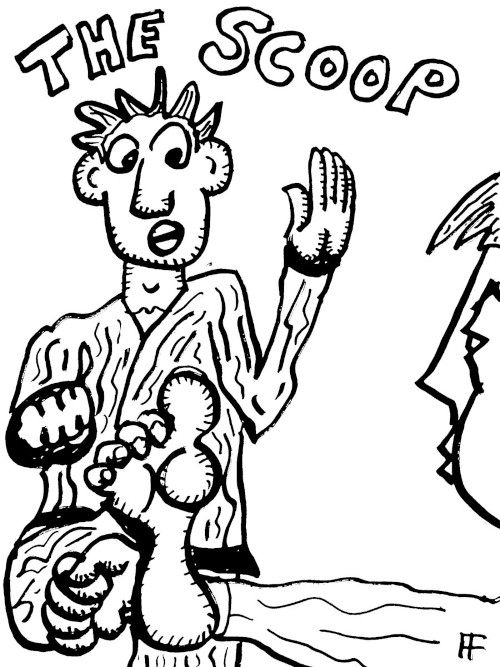
“They have a much different style than our Goju Kai. It’s called Shotokan. They practice less kata and more fighting. They’re well known for their powerful flying footwork. So, I am going to teach you a countermove. I call it the scoop-kick.”
The students began practicing this counter move over and over until it became a reflex action for powerful kicks coming their way. In fact, the scoop-kick became a regular part of their training routine leading up to the tournament.
This counter move consisted of your arm scooping down in a circular motion. Then using your fist you’d catch your opponent’s kicking foot under their heel guiding it away from you while planting a counter strike to your opponent’s exposed mid-section.
The power the opponent put into their kick was used against them. Byron wondered if he could make it work in a real fight. He was soon to find out.
The day of the tournament, Byron arrived on time and ready. His father had reluctantly driven him across the bridge into Seattle on his Saturday off. Byron’s father didn’t come in to watch his son fight; instead, he went to the local University Library to do some reading.
Byron didn’t take it too hard. His father and he didn’t always get along. So he said nothing, but thanks for driving him there.
The tournament was being held in the large university auditorium. There were many Karate schools from all over the northwest of the U.S. and the southwest of Canada. Byron went into the locker room to get into his Gi.
He was a green belt. He wore a fabric brace on his right wrist, which was sore from fights in the last couple of weeks. He thought about this vulnerability and decided to put the wrist support on his opposite uninjured wrist, so if his opponent decided to attack the bandaged injury, it would be the good wrist instead.
The first matches were about to begin. Byron checked in for his age group: 14 years old. He would be paired with another young fighter.
The fighting began. Byron found watching the other style of Karate interesting, and how some fighters were more aggressive than others, and one so aggressive that he actually kicked his opponent in the balls, who let out a blood-curdling scream and fell to the ground. Byron was glad he was wearing a jock strap with a cup to protect himself.
After a while, Byron felt Mother Nature calling. Should he take a pee or hold it? He decided to go to the bathroom. When he got back, he found himself standing there for quite some time. He decided to check on the fighting order and when he was scheduled to fight. The referee checked the list of young fighters and said.
“Byron Woods? We already called your name. You missed your fight. We paired your opponent with another boy.”
Of all the bad luck, Byron thought. He inquired if there wasn’t any way to fight.
“We could pair you with an adult. Sit tight and wait for your name to be called,” said the referee.
Byron waited. It was about 30 minutes before they worked him in. He went to the floor area were the match would be fought. His opponent wasn’t in sight. Then a door opened and in walked a tall, wiry man in his mid-30s, an Australian from Canada. They stood opposite one another and bowed—Byron, 5’9”, 135 pounds vs. Australian 6’5”, 190 pounds. The match began.
The first move the Australian made was one of their Karate style’s famous flying rooster kicks. He sprang into mid-air and launched himself 6 feet across the match area with his right leg extended. The ball of his foot struck into Byron and sent him flying across to the other side of the floor. Wow, Byron thought. This guy isn’t shy about attacking.
Byron immediately got back up on his feet. He was lucky, not injured, just shaken up. The two opponents continued to maneuver with the occasional strike and counter strike, but the stalking of each other was much more apparent. Byron sensed a mean streak in this man and kept alert for his next kick. It was a while before it came, but when it did, it was not a flying kick but a hard straight thrust at Byron’s torso. This time, Byron was ready.
Just as his instructor had taught him, his right arm quickly curved down, and his clenched fist caught under the Australian’s heel and guided it away from making contact, and his opponent went flying onto his rear end. Byron moved in for the strike to his midsection. Byron was on one knee, driving several punches into the other man while he was frantic, trying to maneuver away. It was a surprise for everyone watching. His older classmates in the stand cheered. The desperate look on the Australian’s face said it all. He certainly wasn’t expecting to have the tables turned.
Soon, the opponent was back on his feet, but this time, he was the one who was shaken up. Now the stalking took on a more careful and crafty dimension. The Australian did not exude confidence at the start of the match, but he was no less determined to inflict pain on his opponent. Both fighters were locked in a staring contest.
Circling and breathing hard, trying to dodge each other’s attempts to strike. After a while, the referee called for a timeout. This was rare for the two opponents to take a rest in the middle of a match, but they both got down on folded knees with backs to one another for a few minutes. Then the referee signaled to get up and resume the match.
The two opponents continued to stalk and circle one another. Byron was mainly waiting for the Australian to try another of his powerful kicks, but he was not kicking anymore, just punching. For the most part, Byron did the same; only occasionally did he try a kick, but the Australian always moved out of the way.
The rest of the match was not very exciting for the audience in the bleachers, but it was filled with tension. Finally, the referee called the match over and announced the Australian had won by more points. It was that first kick he landed at the beginning of the match, Byron thought. He also thought it was a bit unfair since he did that counter move, the scoop-kick, and landed a few punches. He felt it was closer to a tie, but not according to the referee.
The following week, their instructor stood before the class and reviewed the tournament’s results. He was generally happy except about Byron missing his scheduled match and said so with his usual humorous sarcasm. Byron didn’t know what to say, so he kept quiet, but deep down, he thought: I fought a man twice my age and size. I even used the counter move successfully in a real match. It was exciting and challenging to fight someone larger and older.
Byron had been rather brave considering the odds. Too bad his instructor didn’t see it that way.
